
• Electronics and Electrical Appliance Testing

    Leverage our testing services and quality audits to ensure that your projects, products, processes, and operations meet—and exceed—quality and compliance standards.

Product Description

What is the Production Part Approval Process (PPAP) and What Does It Entail??

In today’s manufacturing world there has been an increase in the outsourcing of parts or components of various products, this normally results in large order quantities, and with many of these

 manufacturers being overseas longer lead times also results.  As a result, the parts produced must be of good quality the first time and every time they are delivered.  The best way to 

accomplish this is via the Production Part Approval Process or PPAP Process for short.

This PPAP Process was first developed and used in the automotive industry, but today it is used in many different industries to facilitate proper communication between the supplier and the 

customer.  The result of this is fewer revisions and turnbacks of the products or parts produced.

The PPAP is a form of documentation standardized according to the Automotive Industry Action Group (AIAG). It’s one of Core Tools of IATF 16949 to evaluate and improve your Quality 

Management System (QMS). It demonstrates that the supplier fully understands the requirements of the customer. It is comprised of 18 requirements which are also known as elements 

and five (5) PPAP levels of submission.

There is a PPAP manual which gives guidelines in great detail and provides sample documents for proper completion of each element and level of submission. The result is the hard evidence 

which shows that the supplier has met the customer’s requirements and has a process that can consistently produce components of quality.


What is the Purpose of the Production Part Approval Process (PPAP)?

The main purpose of the PPAP is to ensure that the supplier completely understands the customer’s design and to demonstrate that the supplier can produce the component or parts as required by the 

customer consistently.


Q1: Why Perform PPAP?

It is important to carry out this process as it ensures that the supplier is aware of the requirements of the client. It allows the client to become familiar with the quality of the product that will be

 produced and the process involved in making the same. and The PPAP demonstrates that the production process can be trusted to repeatedly produce products of the quality that the client desires.

It also facilitates an understanding between the supplier and the customer that the product will meet the required specification and design.

Please note the PPAP allows changes to be made which are in agreement or accordance with the client’s approval and importantly helps to prevent conflicts after the contract.


Q2: When is a PPAP Process required?

The PPAP Process may be required for several reasons such as when new parts are being added to the product when changes are being made to the product, the tools being used, and the sub-suppliers, or to the process of production.

If there is an interruption to the production process which exceeds twelve (12) months a PPAP may also be required.   The customer can also require that the supplier perform a PPAP if a serious defect is found in the production process or product.


Q3: When to Perform PPAP Process?

The Production Part Approval Process (PPAP Process) should be performed whenever a new part is being added to the processor whenever a change is being made to an existing part.  A customer can also ask that one be done at any point during the product’s lifetime.

As a result, suppliers must ensure that they have a system that is so designed to make and document the various requirements for the PPAP even in cases where one has not been requested.


Q4: How to Perform the PPAP Process?

In performing the PPAP, some parts are manufactured using the tools, procedures, facility, personnel and all other features which are expected to be used in the actual production.  The number of parts that are normally made is set.  The sample pieces are then analyzed in different ways to ensure that the manufacturing process is in agreement with the customer’s request.
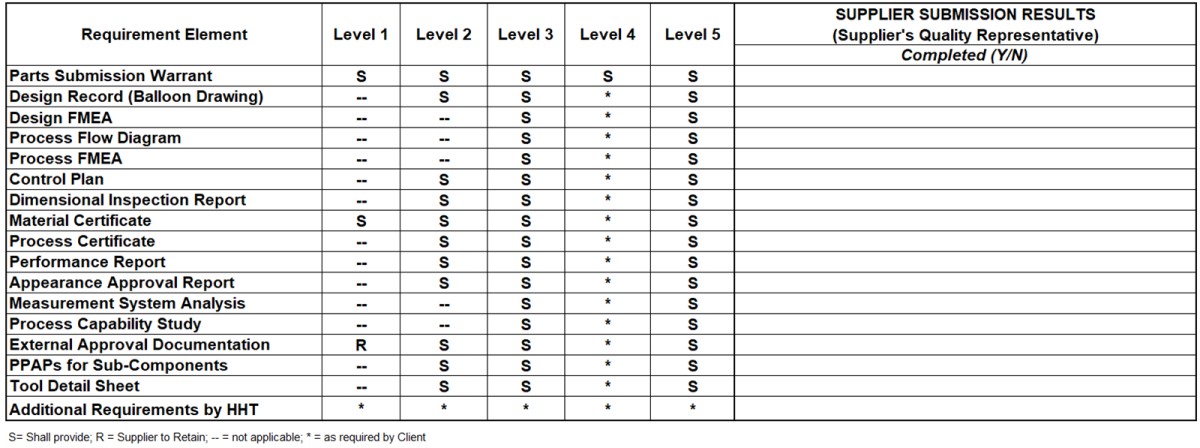
What are the 5 PPAP Submission Levels?

PSW_Part_Submission_Warrant_in_PPAP_Process

There are five (5) submission levels which are associated with the PPAP which are described below:

  • Level 1 – Part Submission Warrant (PSW) only submitted to the customer
  • Level 2 – PSW which has samples of the product and limiting supporting data
  • Level 3 – PSW with a product sample and the complete supporting data
  • Level 4 – PSW and any other requirements based on what the customer desires.
  • Level 5 – PSW with product samples, all of the supporting data for evaluation at the manufacturing location of the supplier.


What are the Required PPAP Elements?

What are the 18 documents of PPAP? As mentioned before there are 18 elements that make up the PPAP and these PPAP elements are: Design records. Engineering change documents. Customer engineering approval.

01

Design Records

This is a drawing of the part being designed. It is normally supplied by the customer with the purchase order.  This drawing is very detailed with including specifications and any information relevant to the part being produced.  This must be included to ensure that the supplier and customer are both discussing the same product.

03

Customer Engineering Approval

This approval involves a trial run with the part that is produced and is not always required. However, when required a ‘temporary deviation’ is needed to facilitate submission of the parts to the customer before the approval of the PPAP.

05

Process Flow Diagrams

The graphical representation of the steps and processes involved in manufacturing a product. These diagrams typically outline all the stages of production from start to the components involved.

07

Control Plan

This results from the PFMEA and provides details on the various inspection methods which are in place to ensure that there is consistent delivery of products which meet the customer’s requirement.

09

Dimensional Results

This demonstrates if the sample product passed or failed the dimension test based on the original requirement as laid out on the drawing of the part.

11

Initial Process Studies – Statistical Process Control (SPC)

This study serves to illustrate that the critical processes are stable, operating close to the nominal value that is intended and shows normal variation. It normally includes the Statistical Process Control.

13

Appearance Approval Report

This is only necessary in cases where the part will contribute to the appearance of the product. The report serves to show that the customer has reviewed the final product, and it has been found to meet the required design.

15

Master Sample

This is the final sample of the part that the customer will inspect and approve. It functions as a benchmark for comparison with other parts that will be produced should the question of quality arise.

17

Records of Compliance with Customer Specific Requirements

This entails any special requirements that the customer may have.

02

Engineering Change Documentation

This is also called the Supplier Product Engineering Change Notice (SPCN) and details any changes that are being made to the product or the process. As a result, it is only required when a change is being made.

04

Design Failure Mode and Effect Analysis (DFMEA)

This analysis involves looking at the design of the part or product and assesses the likelihood of it failing and the effect that this would have on the customer or product. It allows for changes to be made which can possible prevent or lessen the likelihood of these failures.

06

Process Failure Mode and Effects Analysis (PFMEA)

This element evaluates the various steps in the process of production to identify any potential risk to the quality of the product. The controls implemented are then documented.

08

Measurement System Analysis (MSA)

This is a study that incorporates the Gage Repeatability and Reproducibility (GR&R) study on the equipment used for measurement during the control checks on quality and assembly.

10

Records of Material or Performance Tests

The Design Verification Plan and Report (DVP&R) which is a summary of the entire validation test performed on the parts or products should be included in this element. Every test carried out along with the results and the method is to be stated.

12

Qualified Laboratory Documentation

This is made up of the certifications for the various labs that were used in validating the part. The labs could have been in-house or contracted off-site.

14

Sample Production Parts

A sample of the part that is produced is normally sent for approval to the customer once development is complete. This part is then stored at either the suppliers’ or customer’s facility.  This element of the PPAP carries a picture of the part along with information as to where the part is being stored.

16

Checking Aids

This is a list which details all the tools that were used to inspect or test the part.

18

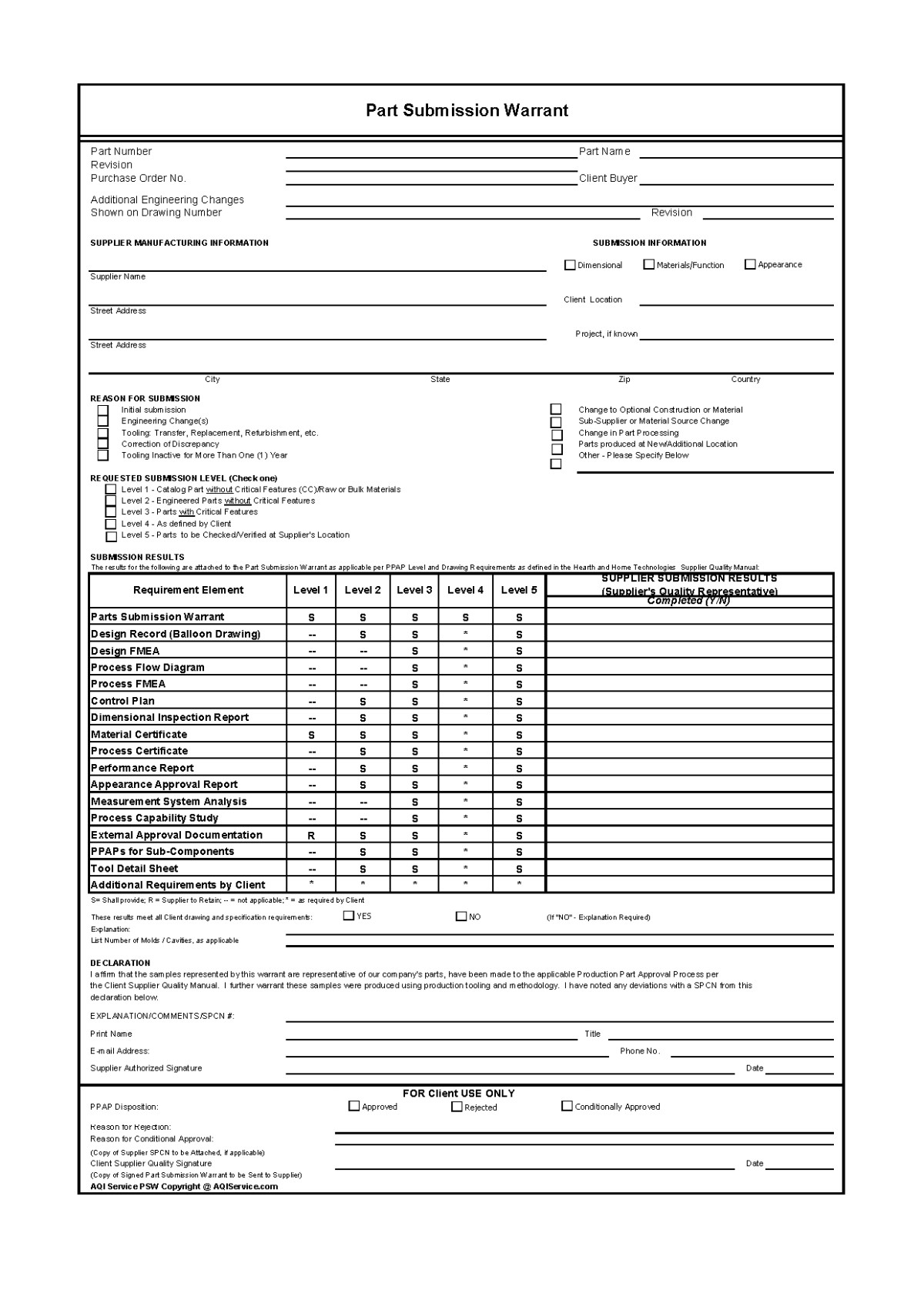
Part Submission Warrant (PSW)

This is a summary of the PPAP that is being submitted.

PPAP PSW FROM AQI SERVICE COMPANY


Customer Reviews

豆包 (12)
Our Company is a world-leading testing, inspection, and certification organization. With over a century of deep expertise in quality compliance and technical services, the company has established a global professional service network under the strategic vision of "Uniting Forces, Connecting the World." The company brings together **99,500 professional technical experts** and operates over 2,500 laboratories and business offices across **115 countries and regions**, forming a comprehensive global testing and certification service system. Upholding a legacy of Swiss-standard rigor and precision, Our specializes in core areas such as testing and inspection, certification services, and sustainability assessments.

Get In Touch With Us

If you want to get the latest progress of the product, please fill in the form below, we will get in touch with you as soon as possible.

Submit